

11 Feb 2026
The Rings of Power: managing nutrient cycles in aquatic food webs above and beyond primary producers
Web Ecol., 26, 27–33, 2026
11 Mar 2025
Future perspectives in the study of mutualistic interactions between insects and their microorganisms
Web Ecol., 25, 39–45, 2025
05 May 2020
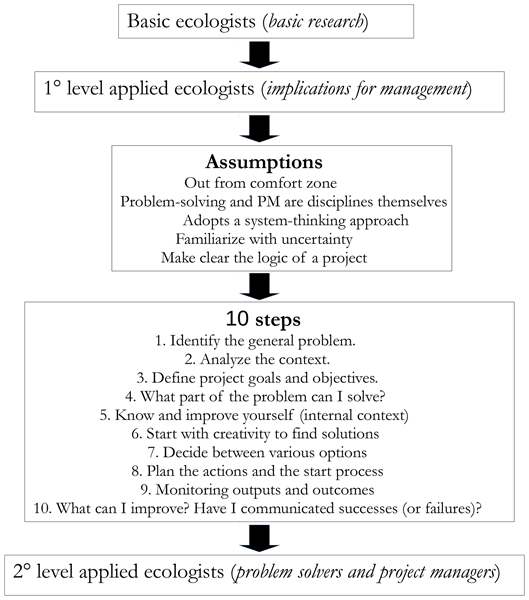
Toward a new generation of effective problem solvers and project-oriented applied ecologists
Web Ecol., 20, 11–17, 2020
14 Mar 2018
Non-native invasive species as paradoxical ecosystem services in urban conservation education
Web Ecol., 18, 37–40, 2018
24 Aug 2017
| Highlight paper
Could disruptive technologies also reform academia?
Web Ecol., 17, 47–50, 2017
09 Nov 2015
| Highlight paper
Contributions to biodiversity theory: the importance of formal rigor
Web Ecol., 15, 33–37, 2015
01 Oct 2015
Workshop summary: "Floods, state, dams and dykes in modern times: Ecological and socio-economic transformations of the rural world"
Web Ecol., 15, 29–31, 2015
14 Jan 2015
| Highlight paper
Demography gone wild in native species: four reasons to avoid the term "native invaders"
Web Ecol., 14, 85–87, 2014
13 Jan 2015
Reply to Mikoláš's comment on "Opinion Paper: Forest management and biodiversity" by Schulze et al. (2014)
Web Ecol., 14, 75–77, 2014
19 Dec 2014
Comment on "Opinion paper: Forest management and biodiversity": the role of protected areas is greater than the sum of its number of species
Web Ecol., 14, 61–64, 2014
28 Oct 2013
The "four-color issue" in ecology for considering ecosystem boundaries
Web Ecol., 13, 91–93, 2013
17 Jun 2009
David and Goliath: comparative use of facilitation and competition studies in the plant ecology literature
Web Ecol., 9, 54–57, 2009
27 May 2009
The “beer vs. science” affair: illuminating drawbacks of current ecology
Web Ecol., 9, 24–29, 2009
15 Feb 2001
"Towards establishing ecology as a science instead of an art": the work of John T. Curtis on the plant community continuum
Web Ecol., 2, 1–6, 2001