
the Creative Commons Attribution 4.0 License.
the Creative Commons Attribution 4.0 License.
 | 06 Aug 2026
Habitat characterization and climate-driven niche shifts of Vampyrodes bats reveal contrasting futures for V. major and V. caraccioli
Sergio Hernández-Rodríguez
Daily Martínez-Borrego
Miguel Jácome-Flores
Frugivorous bats of the genus Vampyrodes (Phyllostomidae) play a vital ecological role through seed dispersal and habitat maintenance in Neotropical forests. However, they are increasingly threatened by habitat loss and climate change. This study examined the current and potential future distributions of V. major and V. caraccioli to assess their ecological requirements and evaluate conservation challenges. We compiled occurrence records from literature and databases, selecting relevant climatic variables to develop environmental niche models using the Maxent algorithm. Model performance was optimized by comparing multiple parameter combinations and validated through established statistical criteria. V. major shows relatively stable climatic suitability areas under both low-emission (SSP1-2.6) and high-emission (SSP5-8.5) scenarios, suggesting broader climatic niche breadth. By contrast, V. caraccioli faces substantial losses of climatically suitable areas – up to 50 % in the most extreme emission scenario – especially in the Amazon basin. The projected reduction of climatic suitability within protected areas further highlights the vulnerability of V. caraccioli, raising concerns about their long-term viability and the potential disruptions to seed dispersal networks. Conversely, while V. major retains climatically suitable areas in protected zones, ongoing deforestation and fragmentation remain significant threats. These findings underscore the importance of formulating differentiated conservation strategies for each species. Specifically, bolstering corridor networks, preserving intact forest patches, and developing climate change mitigation policies are critical to safeguarding these bats' ecological functions. By providing a clearer understanding of present and future distributional patterns, this study aims to guide more effective, science-based management of Vampyrodes species across their geographic range.
- Article
(4781 KB) - Full-text XML
-
Supplement
(575 KB) - BibTeX
- EndNote


In the Neotropics, bats of the family Phyllostomidae play a fundamental role in maintaining tropical ecosystem functioning (Mancina et al., 2012). Beyond dispersing the seeds of numerous native plant species, phyllostomid bats also provide key ecosystem services such as pollination of chiropterophilous plants, regulation of arthropod populations, nutrient redistribution through guano deposition, and contribution to genetic connectivity across fragmented landscapes (Fleming et al., 2009; Kunz et al., 2011). These services are critical for sustaining plant reproduction, trophic dynamics, and ecosystem resilience in Neotropical forests (Medellín and Gaona, 1999; Lim and Engstrom, 2001; Muscarella and Fleming, 2007). Given their close ecological relationships with the plants they depend on, these tropical bats are facing numerous threats such as habitat loss and climate change (Pereira et al., 2010; Rebelo et al., 2010; Sherwin et al., 2012; Festa et al., 2023; Fialas et al., 2025; Van et al., 2025). While the effects of habitat loss have been well documented, the specific consequences of climate change on bats' distribution and functional roles remain poorly understood.
The increasing frequency of extreme weather events, such as heatwaves and droughts, poses a significant threat to bat populations (Welbergen et al., 2008; Salinas-Ramos et al., 2023). These extremes are particularly relevant for bats because they often roost in cavities or foliage where temperatures can rise rapidly, and their thermoregulation under heat stress is constrained, increasing the risk of hyperthermia and dehydration, which can lead to mass mortality events (Welbergen et al., 2008). These events, exacerbated by the effects of global climate change, can reduce the availability of suitable roosting and foraging areas for tropical bats (Meyer et al., 2016). This concern is particularly relevant in the Amazon region, where climatic extremes such as severe drought and anomalous warming have been documented in recent years (Espinoza et al., 2024), within a highly heterogeneous and dynamic landscape (Hoorn et al., 2010). These alterations not only reduce bat populations but also directly impact ecosystem services, such as seed dispersal, and affect long-term ecosystem health and stability (Festa et al., 2023). The implications of these changes highlight the need for conservation strategies that integrate both adaptation and mitigation of climate change to protect bats and the ecosystems they depend on (Aguiar et al., 2016). In this context, ecological niche modelling (ENM) analyses enable the identification of current areas with suitable climatic conditions for populations and those regions that could offer refuge under future climatic scenarios (Festa et al., 2023). This information is critical to adapting and expanding protected areas, prioritizing climate stability zones that serve as long-term natural refuges (Arroyo-Rodríguez et al., 2020). Additionally, ENM facilitates the identification of potential ecological corridors necessary to maintain connectivity between fragmented habitats, reducing the risk of population isolation and promoting species' resilience to future environmental changes (Fahrig, 2003).
This is concerning, especially for genera like Vampyrodes, whose species are particularly susceptible to disturbances in vegetation because they depend on plants not only for food but also for shelter (Morrison, 1980). There are few studies focused on this genus, but all of them have considered their species as bioindicators, primarily due to their exclusive presence in well-preserved forests spanning from southern Mexico to southeastern Brazil (Téllez-Girón, 2005; Velazco et al., 2010). However, recent studies have reported the occurrence of these bats in ecosystems undergoing ecological restoration, where secondary vegetation predominates (García-Morales et al., 2022). This suggests that their habitat tolerance may be broader than previously assumed, highlighting the need for further studies on their resilience under changing environmental conditions.
The taxonomic history of Vampyrodes has been controversial as the number of species has varied through time, in part because the genus represents a cryptic species complex. Originally this genus was proposed as a subgenus of Vampirops (Thomas, 1889), but Miller (1907) elevated it to the generic level. Handley (1966) recognized it as a monotypic genus with the species V. caraccioli and two subspecies: V. caraccioli caraccioli and V. c. major. According to this classification, V. c. caraccioli was distributed from Colombia to southeastern Brazil, while V. c. major was confined from southern Mexico to the Colombian Andes. Based on phylogenetic results using the mitochondrial cytochrome b gene and a comprehensive review of cranial morphology, Velazco and Simmons (2011) recognized V. caraccioli and V. major as valid species. This study is considered the most significant contribution to the genus, with the taxonomic classification remaining unchanged. Most research on Vampyrodes has primarily addressed taxonomic and morphological questions, as well as reporting new locality records for both species (Velazco and Simmons, 2011; Carvalho et al., 2014; Althoff et al., 2017; García-Morales et al., 2022). Despite the IUCN categorizing both species as Least Concern based on their wide geographic distribution (Miller et al., 2016; Solari, 2016), there is still a notable lack of information regarding ecological characteristics, environmental preferences, population trends, and broader conservation needs, which is essential for potentially recategorizing their current conservation status.
In this study, we assess how climate structures the ecological variation and geographic suitability of Vampyrodes and how these patterns may shift under future climates. Focusing on V. major and V. caraccioli, we characterize their climatic associations; evaluate whether niches are conserved or differentiated within the genus; and quantify projected changes in suitability as loss, gain, and stability. We then examine the overlap between present and future suitable areas and the protected area network to identify climatically stable zones and conservation priorities. Based on the genus's reliance on forest resources and the documented sensitivity of bats to climatic stressors, we expect partial overlap between species and a scenario-dependent reconfiguration of suitable areas, with stable suitability not necessarily coinciding with existing protected areas. Overall, our results provide an updated picture of climatic suitability for Vampyrodes and a basis for conservation planning and policy-oriented recommendations under ongoing environmental change.
2.1 Study area
The analyses were carried out in the tropical and subtropical regions from Central America to South America according to the geographical distribution of the genus Vampyrodes (Velazco and Simmons, 2011). The distribution of V. major is concentrated in Central America, spanning from southern Mexico to Colombia (Velazco and Simmons, 2011; García-Morales et al., 2022). V. caraccioli occupies a broader area in South America where it predominates in the Amazon basin, the Andean regions, and tropical zones of southern Brazil, extending from Venezuela to central Bolivia and Peru (Fig. 1) (Velazco and Simmons, 2011; Althoff et al., 2017). These areas exhibit high spatial and environmental heterogeneity, incorporating diverse mosaics such as highland mountain ranges, floodplains, mangroves, swamps, coastal regions, and savannas interconnected by other hydrographic basins and the Amazon rainforest (Hoorn et al., 2010; Antonelli et al., 2018). The climate in the region is tropical, predominantly of the Af (equatorial rainforest, fully humid) and Am (equatorial monsoon) types, according to the Köppen classification (Peel et al., 2007). The average precipitation is between 2200 and 3100 mm, whereas temperatures range from 20 to 26 °C (Alvares et al., 2013).
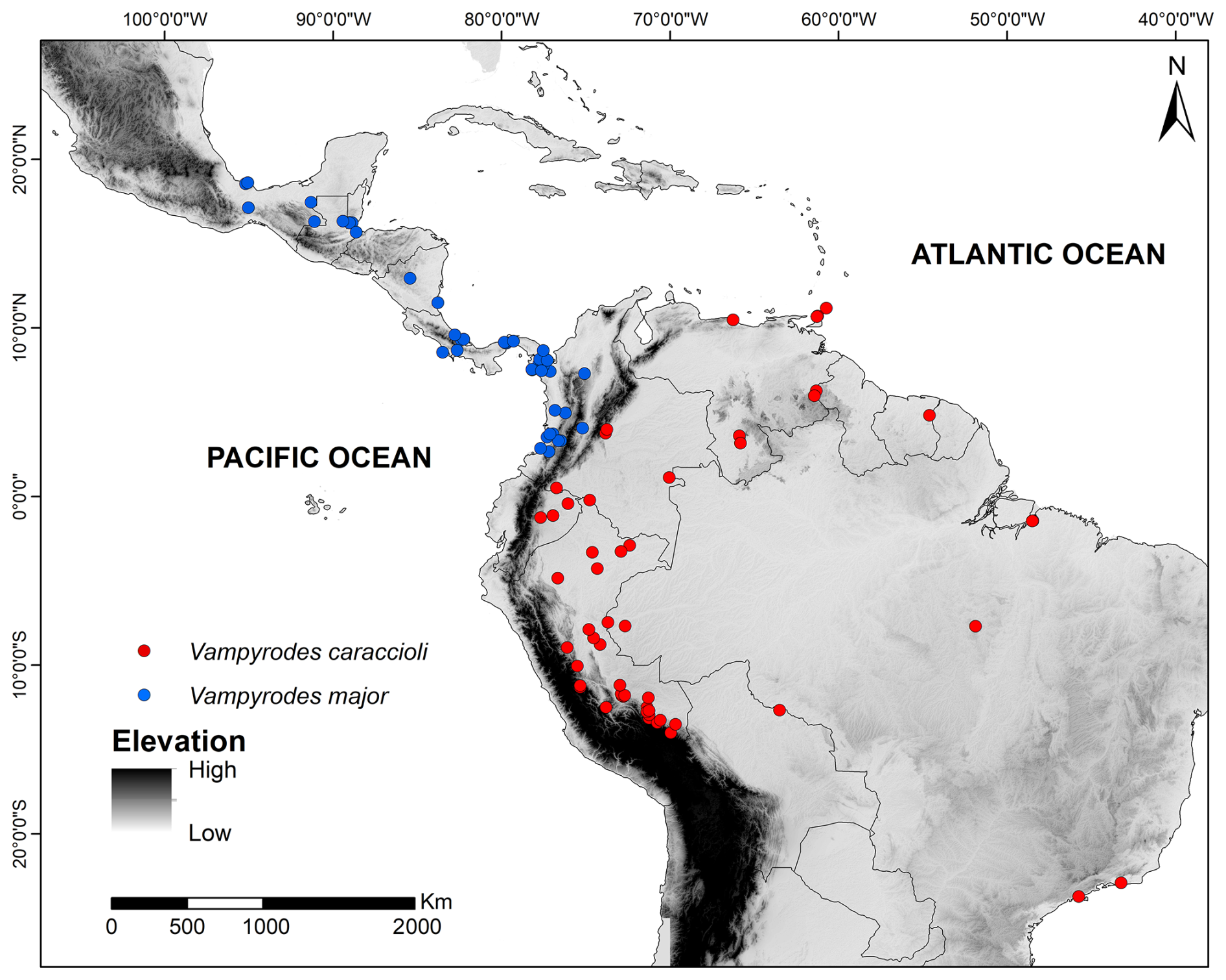
Figure 1Spatial distribution of occurrence records for Vampyrodes major (blue dots) and V. caraccioli (red dots) across Central and South America.
2.2 Occurrence records and bioclimatic variables
Occurrence records for V. major and V. caraccioli were obtained from literature and the GBIF (Global Biodiversity Information Facility, 2025; http://www.gbif.org, last access: 3 August 2025) database. Distribution records from the literature included the localities reported by Velazco and Simmons (2011) because of a taxonomic revision of museum specimens, as well as new reports for both species (Althoff et al., 2017; García-Morales et al., 2022). We did not include citizen-science records (e.g. iNaturalist) because the cryptic nature of Vampyrodes increases the risk of misidentification in non-vouchered observations; therefore, we restricted occurrences to published and GBIF records with a verifiable taxonomic basis. Specimen occurrences were filtered to exclude non-georeferenced data, duplicate records, and those outside of the natural species ranges. The final database comprised 190 presence records, of which 113 correspond to V. caraccioli and 77 to V. major. To contextualize interspecific differences in modelled climatic breadth, we summarized the distribution of filtered occurrence records across terrestrial ecoregions using the WWF ecoregional framework proposed by Olson et al. (2001). Occurrence points were spatially intersected with the ecoregion layer, and records were counted per ecoregion for each species. This summary was used as descriptive support for the geographic–environmental coverage of the occurrence dataset and not as a direct test of ecological flexibility.
Bioclimatic variables were obtained from the WorldClim 2.1 database (Fick and Hijmans, 2017; http://www.worldclim.org, last access: 3 August 2025) and used as descriptive variables (temperature and precipitation) in the subsequent analysis. We used 15 bioclimatic variables to characterize the habitat's climatic conditions. However, a reduced subset of variables (see Sect. 2.4) was used for ENM calibration after excluding highly correlated predictors. In our analyses, bioclimatic variables bio8, bio9, bio18, and bio19 were excluded due to abrupt discontinuities in areas lacking characterization caused by geographic breaks (Escobar et al., 2015; Alkishe et al., 2022; Contreras-Díaz et al., 2023). This consideration was applied to the climatic characterization and the development of ecological niche models. Given the broad known distribution of both species, a 2.5 arcmin resolution (∼5 km at the Equator) was selected to characterize climatic conditions and to build present and future ecological niche models. This resolution was chosen due to its ability to capture the spatial dynamics of climatic variables without compromising computational efficiency (Aiello-Lammens et al., 2015; Álvarez et al., 2021). In addition, we retained this grain to avoid pseudo-precision when modelling with compiled occurrence records that may include heterogeneous positional uncertainty. Because locational error can propagate into ENM calibration and spatial predictions (especially when predictor resolution is finer than the effective accuracy of occurrences), we considered ∼5 km an appropriate and defensible compromise for the regional-scale inference of climatic suitability and its projected changes (Graham et al., 2008).
2.3 Climatic variability and niche overlap quantification
The bioclimatic variables mentioned above summarized the climatic niche characteristics of Vampyrodes species. We calculated descriptive statistics (mean, standard error, maximum and minimum values, standard deviation, and coefficient of variation) to determine each species' environmental range using data obtained from occurrence records. We performed Mann–Whitney U tests for each bioclimatic variable in Statistica 8.0 as complementary univariate summaries of differences in occurrence-associated climatic conditions between V. major and V. caraccioli. This non-parametric statistical test was selected for the comparisons because the primary data did not meet the assumptions required to perform parametric tests based on a normal distribution.
Niche overlap analyses were conducted in R using ecospat in PCA-env space (Broennimann et al., 2012; Di Cola et al., 2017). Bioclimatic variables (WorldClim 2.1, 2.5 arcmin) were obtained with geodata, excluding bio08, bio09, bio18, and bio19 a priori. Species-specific background environmental space was defined from the accessible area (M) under the BAM framework using minimum convex polygons (MCPs) based on filtered occurrences, and background points were sampled within each M using only raster cells with complete values across all predictors (target = 20 000 points per species). A PCA (PCA1–PCA2) was calibrated on the combined background environments of both species (ade4::dudi.pca, nf = 2), and environmental occupancy grids were built with ecospat.grid.clim.dyn (R=100, th.sp = 0). We quantified overall niche overlap with Schoener's D and Hellinger-based I (ecospat.niche.overlap, cor = TRUE), and performed niche similarity and equivalency randomization tests (ecospat.niche.similarity.test, ecospat.niche.equivalency.test) with 5000 permutations. Directional niche-dynamics components (stability, expansion, unfilling) were estimated with ecospat.niche.dyn.index (intersection = 0) in both species directions, and centroid shift was calculated as the Euclidean distance between species niche centroids in PCA-env space. Because neither species is invasive, expansion and unfilling were interpreted as directional niche-difference components rather than invasion dynamics.
2.4 Ecological niche models for present and future scenarios
We conducted a Spearman correlation test to exclude highly correlated bioclimatic variables. This non-parametric equivalent test was used because exploratory analyses showed that the data did not meet the assumptions of parametric tests. The analysis was performed using the ntbox library in R (Osorio-Olvera et al., 2020), which identified the variables to be used for modelling each species by filtering those summarizing the environmental information of occurrence data based on a correlation threshold of 0.75 (Hernández-Chávez et al., 2023). For both species, the least correlated variables were bio1 = annual mean temperature, bio4 = temperature seasonality (standard deviation ×100), bio7 = temperature annual range, bio10 = mean temperature of warmest quarter, bio12 = annual precipitation, and bio13 = precipitation of wettest month.
To assess the potential impact of climate change on the climatic suitability areas of both species, we used five general circulation models (GCMs; ACCESS-CM2, BCC-CSM2-MR, CMCC-ESM2, CNRM-CM6, and MIROC6) under two Shared Socioeconomic Pathway scenarios (SSP1-2.6 and SSP5-8.5) for the 2041–2060 period. Rather than relying on a single GCM, we used these models as an ensemble to capture inter-model (structural) uncertainty and to obtain a more robust and comprehensive view of potential future climatic conditions. Future ensemble projections were generated by calculating the median suitability value across the five GCMs for each SSP scenario. Using GCM ensembles minimizes discrepancies in climatic variables and reduces model uncertainty (Araújo and New, 2006). This approach reduces dependence on any single model structure and facilitates the identification of consistent patterns across projections, while keeping the analyses tractable and interpretable at the regional scale. The selected GCMs represent a practical subset of CMIP6 projections with broad use in climate impact assessments and relevance for biodiversity-sensitive regions such as the Neotropics (Eyring et al., 2016; Eyring et al., 2019). SSP1-2.6 outlines a sustainability-oriented future characterized by economic development, strong investments in health and education, and effective global governance (O'Neill et al., 2016), with mitigation efforts aimed at limiting warming to below 2 °C (Riahi et al., 2017). In contrast, SSP5-8.5 represents a fossil-fuel-intensive development pathway with limited climate mitigation and substantially higher warming by 2100 (Riahi et al., 2017; Meinshausen et al., 2020). Projections of the bioclimatic variables were obtained from WorldClim 2.1 using the same spatial resolution as the current data.
2.4.1 Data processing, parameterization, and validation of ENM
The final occurrence database was spatially filtered using the spThin package (Aiello-Lammens et al., 2015) in R version 4.3.1 (R Core Team, 2024). This step was necessary to reduce spatial autocorrelation and to avoid model overfitting due to the presence of multiple records within the same pixel or very close records (Aiello-Lammens et al., 2015). A minimum distance of 10 km between pairs of points was used, considering the spatial resolution of the bioclimatic variables and the dispersal capacity of the bats (Mello et al., 2021). The calibration area was defined based on the BAM framework (Soberón and Peterson, 2005), with special emphasis on delimiting the accessible region (M). Calibration areas for each species were defined using minimum convex polygons based on the filtered presence data. With these areas properly defined, 10 000 background points were generated for the ENMs.
We used the Maxent algorithm (Phillips et al., 2006) to build ENMs for each Vampyrodes species, implemented in the Wallace package in R (Kass et al., 2018). Separate models for each species were constructed and evaluated to select those with optimal parameters, using combinations of five feature class configurations: L, LQ, H, LQH, and LQHP (where L = linear, Q = quadratic, H = hinge, and P = product), along with different regularization multipliers (ranging from 0.5 to 6.0 in 0.5 increments). Model parameterization was determined using the ENMeval 2.0 package in R (Kass et al., 2021). Final models were selected based on the predicted performance with the omission rate (OR <0.05) and model complexity with the lowest corrected Akaike information criterion (AICc; Akaike, 1974; Hurvich and Tsai, 1993). To provide a concise interpretation of predictor relevance, we also inspected Maxent Java variable-importance outputs for the final selected configurations, using the same predictor set, feature classes, and regularization multipliers. These outputs were used only as complementary descriptors of predictor relevance and not for model selection. To evaluate the potential impact of climate change on the climatic suitability of both species, the current climatic niche was transferred to the previously described SSP scenarios, using the projection layers of the selected bioclimatic variables and the five GCMs.
2.4.2 Post-processing analysis based on ENMs
Binary maps were generated using the 10-percentile threshold, representing a 10 % probability that occurrence points fall outside the predicted potential distribution areas (Torres-Olave et al., 2018; Hernández-Chávez et al., 2023). Future projections were obtained from the ensemble outputs described above, based on the median suitability value across the five GCMs for each SSP scenario. Changes between current and future scenarios were quantified by assessing loss, gain, and stability areas. These analyses were conducted in the ArcGIS 10.8 software (ESRI, 2020). Environmental similarity in projected areas was evaluated using the multivariate environmental similarity surfaces (MESS) approach implemented in Wallace (Kass et al., 2018; Elith et al., 2010). This method identifies areas where environmental conditions exceed the range observed in the model training data, which is essential for evaluating prediction reliability in new areas. Additionally, MESS highlighted high-uncertainty regions, facilitating a cautious interpretation of predictions (Elith et al., 2010).
2.5 Protected area gap analysis for Vampyrodes species
We conducted a protected area gap analysis for V. major and V. caraccioli under current and future climatic scenarios using data from the World Database on Protected Areas (WDPA; http://www.protectedplanet.net, last access: 3 August 2025). The WDPA layer was adjusted and cropped to match the spatial resolution and extent of the climatic suitability models obtained for both species, allowing us to quantify the area and percentage of climatically suitable conditions currently represented within protected areas. This analysis was performed in ArcGIS 10.8 based on the final ensemble models for current and future projections.
3.1 Ecoregion representativity, climatic variability, and niche overlap quantification
As a descriptive complement to the climatic niche analyses, filtered occurrence records of Vampyrodes major were distributed across 23 terrestrial ecoregions (77 records), whereas V. caraccioli was represented in 20 ecoregions (113 records). The best-represented ecoregion for V. major was the Petén-Veracruz moist forests (32.5 % of records), while V. caraccioli was most strongly represented in the Guianan moist forests (28.3 % of records). These data provide additional context for the geographic and environmental coverage of the occurrence records used in the analyses, but they are not interpreted as direct evidence of ecological flexibility.
The ranges of temperature and precipitation estimated from the bioclimatic variables (bio1–bio17) showed broadly comparable climatic envelopes for both species, although differences were observed in the amplitude of values and in associated variability (Table 1). For annual mean temperature (bio1), V. caraccioli showed a mean of 24.1 °C (range: 5.4–27.0 °C; SD = 3.3 °C), whereas V. major had a mean of 24.7 °C (range: 16.7–27.4 °C; SD = 2.5 °C). Thus, mean values were similar, but the observed ranges and variability differed between species. A comparable pattern was observed for several temperature-related variables (e.g. bio2, bio3, bio4, bio7), where differences were expressed more in the distribution and variability of values than in central tendency alone (Table 1). In terms of precipitation (bio12–bio17), both species spanned a broad range of moisture conditions, but they differed in how precipitation regimes were represented across their occurrence environments. For example, annual precipitation (bio12) averaged 2959.5 mm (range: 1641–7012 mm) in V. major and 2596.2 mm (range: 852–5791 mm) in V. caraccioli. In addition, precipitation of the driest quarter (bio17) showed high variability in both species, with a higher coefficient of variation in V. major (CV = 90.9) than in V. caraccioli (CV = 55.1) (Table 1). The complementary Mann–Whitney U tests showed statistically significant univariate differences in several occurrence-associated climatic variables (Table 1). Rather than indicating a simple temperature-versus-precipitation contrast, these results support species differentiation along specific climatic dimensions, particularly variables related to temperature variability and dry-season moisture conditions, consistent with the partial separation observed in PCA-env space and the niche-dynamics analyses.
Table 1Climatic characterization of the distribution areas of Vampyrodes caraccioli and V. major based on 15 bioclimatic variables. Temperature and precipitation variables are expressed in °C and mm, respectively. Variables in bold indicate statistically significant differences between species according to the Mann–Whitney U test (p value ≤0.05).
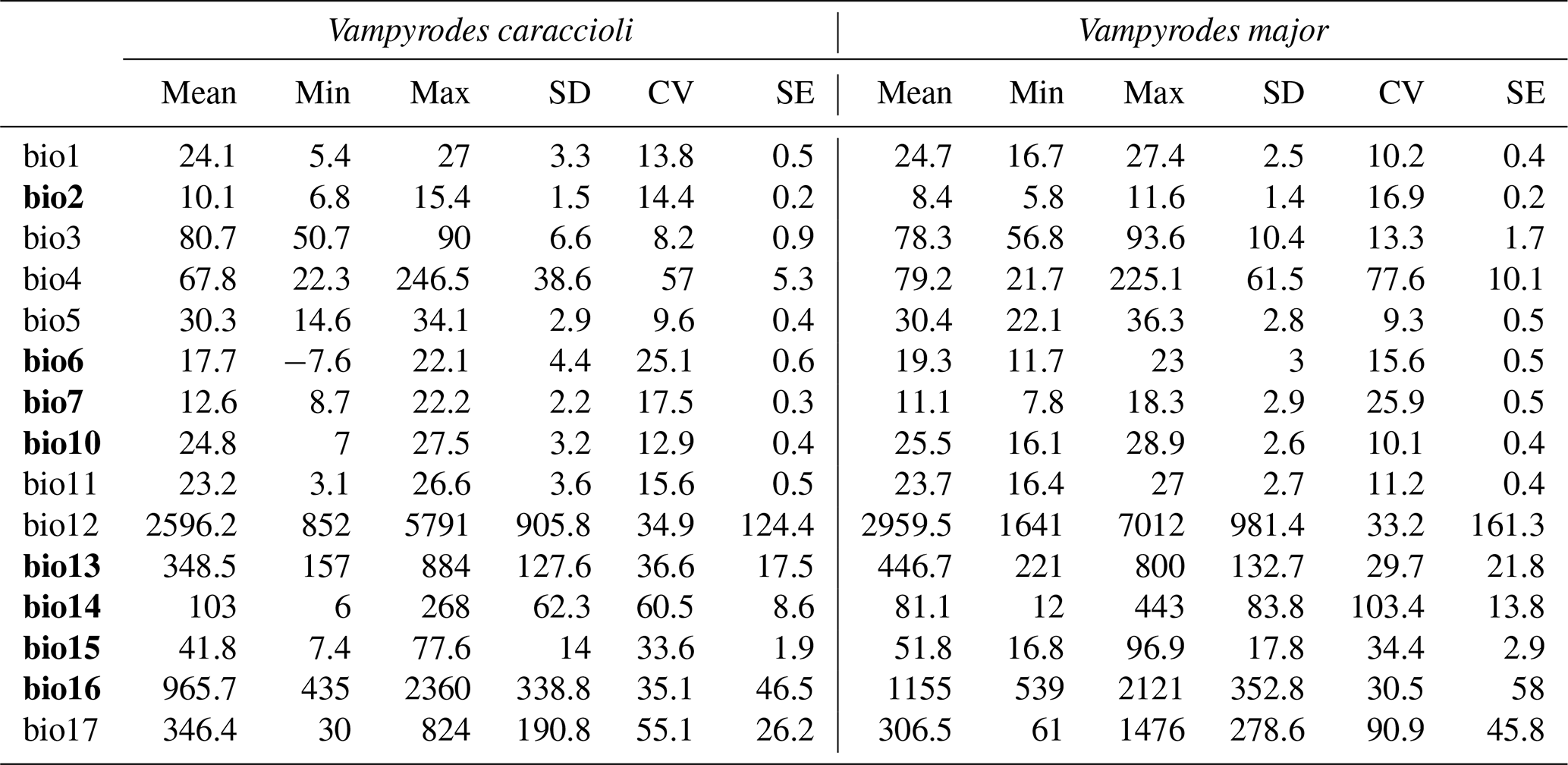
bio1 = annual mean temperature, bio2 = mean diurnal range (mean of monthly (max temp − min temp)), bio3 = isothermality (bio2 bio7 × 100), bio4 = temperature seasonality (standard deviation × 100), bio5 = max temperature of warmest month, bio6 = min temperature of coldest month, bio7 = temperature annual range (bio5 − bio6), bio10 = mean temperature of warmest quarter, bio11 = mean temperature of coldest quarter, bio12 = annual precipitation, bio13 = precipitation of wettest month, bio14 = precipitation of driest month, bio15 = precipitation seasonality (coefficient of variation), bio16 = precipitation of wettest quarter, bio17 = precipitation of driest quarter.
The climatic niche overlap between Vampyrodes caraccioli and V. major in environmental (PCA-env) space is shown in Fig. 2. The distribution of environmental conditions along the first two principal components (PC1 and PC2) indicates a partially shared environmental space, with both species overlapping in a central region of PCA space but also occupying species-specific sectors (Fig. 2A–B). The first two PCA axes explained 75.70 % of the total environmental variance, with PC1 accounting for 53.06 % and PC2 for 22.64 %. The observed niche overlap was moderate (Schoener's D=0.398; Hellinger-based I=0.575). In the niche similarity tests, the observed values were not in the extreme tails of the null distributions (D: p=0.0664; I: p=0.0874), indicating no evidence that the observed overlap is greater than expected under the similarity null framework (i.e. no support for niche similarity beyond background structure). In contrast, the niche equivalency tests yielded high p values (D: p=0.832; I: p=0.935), indicating that strict niche equivalency was not rejected under the randomization framework. Overall, the results indicate broad but partial climatic niche overlap, with no evidence that similarity is greater than expected under the selected ecospat similarity null.
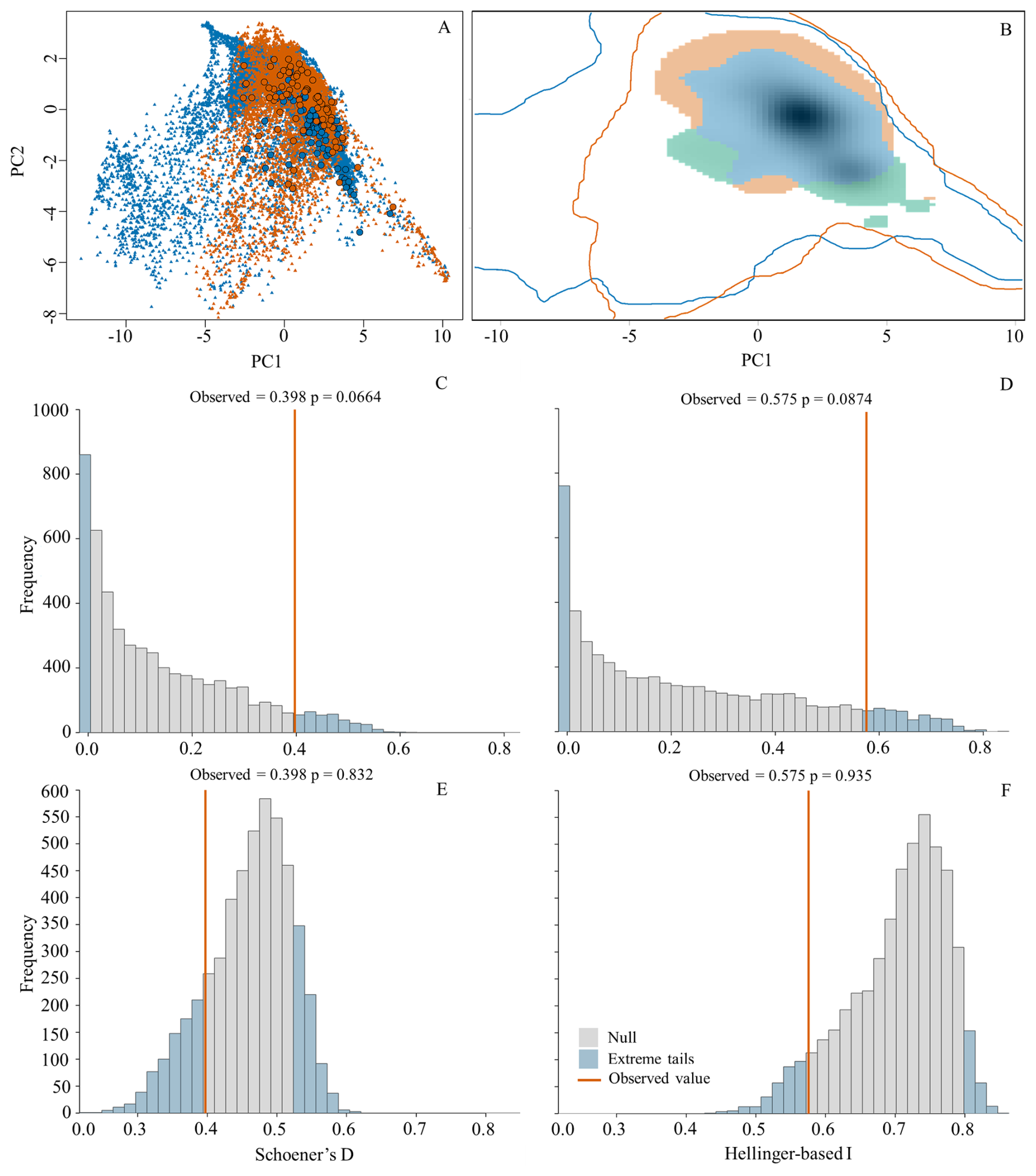
Figure 2Environmental niche comparison in PCA-env space between Vampyrodes major (orange) and V. caraccioli (blue). (A) Distribution of data in the environmental space defined by the first two principal components (PC1 and PC2): circles represent real occurrence records, and triangles represent the species-specific background. (B) Niche occupancy representation in PCA-env space, showing the smoothed occurrence density and niche contours for both species (blue contours = V. caraccioli; orange contours = V. major). Coloured areas represent niche dynamics: blue indicates niche stability (shared environmental space), orange indicates niche expansion of V. major relative to V. caraccioli, green indicates niche unfilling (environmental space occupied by V. caraccioli but not by V. major), and light grey indicates environmental conditions outside the available niche space. Darker shading reflects higher occurrence density in environmental space. (C) Histogram of the null distribution for the niche similarity test using Schoener's D. (D) Histogram of the null distribution for the niche similarity test using the Hellinger-based I index. (E) Histogram of the null distribution for the niche equivalence test using Schoener's D. (F) Histogram of the null distribution for the niche equivalence test using the Hellinger-based I index. In histograms (C–F), grey bars indicate the null distribution, blue bars indicate the extreme tails, and the orange vertical line indicates the observed value (with its corresponding p value shown in each panel).
To further describe the niche relationship beyond overall overlap and randomization tests, we quantified centroid displacement and directional niche-dynamics components in PCA-env space. The distance between niche centroids (PCA1-PCA2) was 1.486, indicating a measurable shift in the central tendency of climatic space between species despite their broad overlap. Directional niche dynamics showed high stability in both comparisons, with stability = 0.859 for V. caraccioli relative to V. major and 0.925 for V. major relative to V. caraccioli. This indicates that most of the climatic niche space of each species is represented within the niche of the other. Non-overlapping components were comparatively small but asymmetric: for V. caraccioli − V. major, expansion = 0.141 and unfilling = 0.075, whereas for V. major − V. caraccioli, expansion = 0.075 and unfilling = 0.141.
3.2 Ecological niche models for present and future scenarios
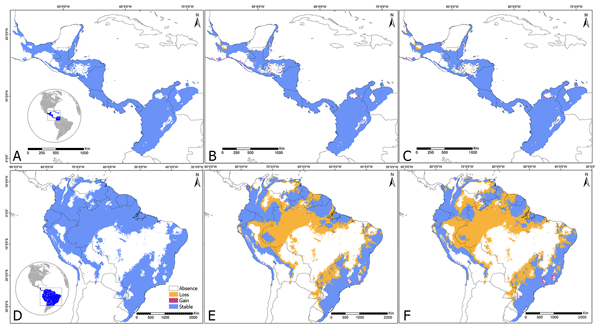
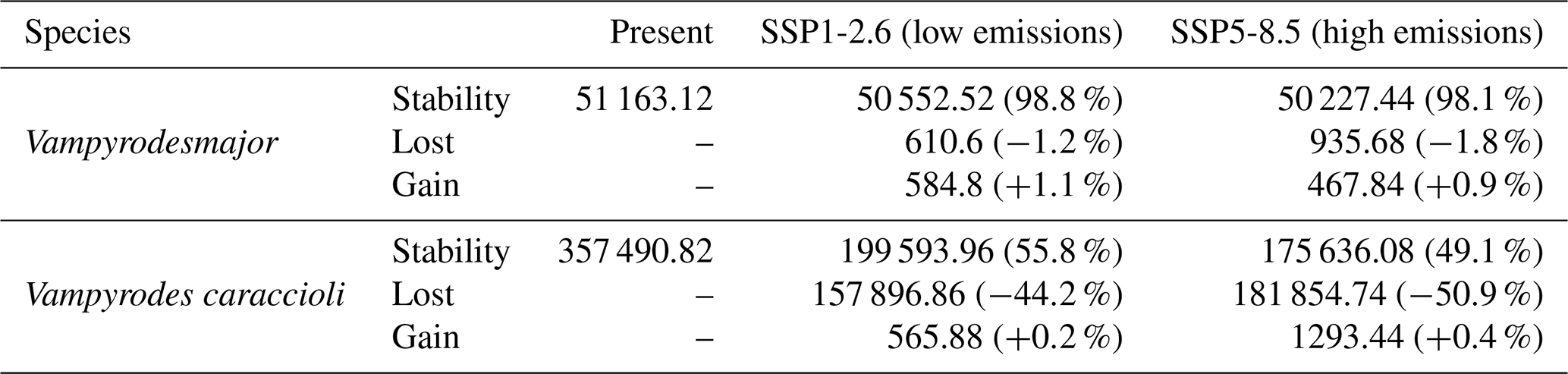
A total of 120 candidate models were obtained for each Vampyrodes species. The final model selected for V. major included linear features with a regularization multiplier of 1, while the best model for V. caraccioli was linear, quadratic and hinge features with a regularization multiplier of 3 (Sect. S1 in the Supplement). Complementary variable-importance outputs indicated that the final model for V. major was mainly influenced by temperature annual range (bio07; 67.9 % permutation importance), followed by temperature seasonality (bio04; 10.0 %) and precipitation of the wettest month (bio13; 8.6 %). For V. caraccioli, the most relevant predictors were annual precipitation (bio12; 37.2 %), temperature annual range (bio07; 25.9 %), and annual mean temperature (bio01; 17.0 %). These outputs are interpreted only as complementary descriptors of predictor relevance. The climatic suitability areas (CSAs) for V. major are mainly distributed across Central America and northern South America. Under the current climatic conditions, approximately 51 163.12 km2 within this region was identified as suitable for this species (Fig. 3A; Table 2). In contrast, the CSAs for V. caraccioli are restricted to South America, covering an estimated area of 357 490.82 km2 (Fig. 3D; Table 2). The predicted distribution of this species included large portions of the Amazon basin, particularly in Brazil, Colombia, Venezuela, Guyana, and Suriname, as well as regions of Peru, Ecuador, Bolivia, and Paraguay.
Projections under future climate scenarios indicate minimal changes in the suitable areas for V. major (Fig. 3B–C). Stability in climatic suitability was observed in approximately 98 % of the currently suitable area under both low- and high-emission scenarios (Table 2). Most of these stable areas (in blue) are distributed across Central America, the northern Andes, and northern South America. Additionally, the predictable suitability areas of gains (0.9 %–1.1 %) or losses (1.2 %–1.8 %) were low for this species.
For V. caraccioli, projection indicated a reduction in the current suitability areas under both climate future scenarios (Fig. 3E–F; Table 2). Losses in suitable areas range from 44 % under the low-emission scenario to 50 % under the high-emission scenario, predominantly across the Amazon basin (highlighted in red). Gains in suitable areas are limited for both species in both scenarios (Table 2). The MESS analysis found areas of strict extrapolation outside the current distribution range of both species. In general, high similarity was recorded between the calibration area and the respective projection scenario (Sect. S2).
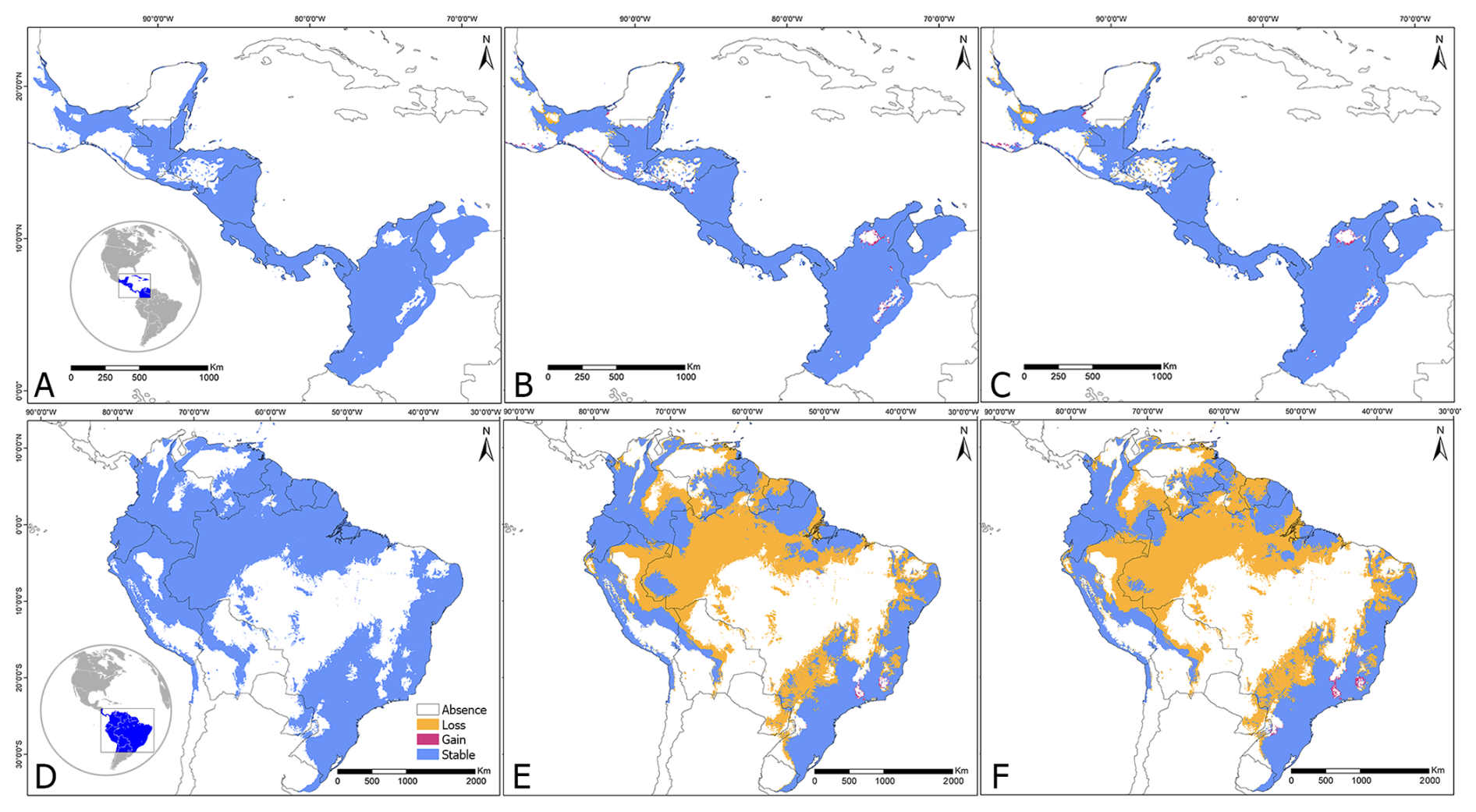
Figure 3Climatic suitability areas for Vampyrodes major (A–C) and V. caraccioli (D–F) under the current climatic conditions (A, D) and future scenarios SSP1-2.6 (B, E) and SSP5-8.5 (C, F). Colours indicate current and projected future suitability.
Table 2Stability, gain, and loss of climatic suitability areas (km2) for Vampyrodes major and V. caraccioli under current and future climate scenarios, based on ecological niche models.
3.3 Protected area gap analysis for V. caraccioli and V. major
Relatively large areas of overlap were observed between the projected distributions of each Vampyrodes species (under current and future scenarios) and existing protected areas (Fig. 4). For V. major, the climatic suitability areas (in blue) intersect with protected areas (in green) across Central America and parts of South America. Under current climate conditions (Fig. 4A), approximately 10 463.62 km2 of climatically suitable area falls within protected areas (20.5 %). This extent remains relatively stable under both the low-emission scenario (10 405.14 km2, corresponding to 20.3 % of the projected climatically suitable area) and the high-emission scenario (10 370.74 km2, 20.5 %) (Fig. 4B–C). In contrast, V. caraccioli shows a much larger extent of current suitable climate within protected areas, covering approximately 91 216.76 km2 (25.5 %), mostly in the Amazon basin regions (Fig. 4D). Projections under future climate scenarios exhibited a substantial contraction of climatically suitable areas for V. caraccioli within protected areas, decreasing to 48 516.90 km2 (24.2 %) under the low-emission scenario and to 39 795.00 km2 (22.5 %) under the high-emission scenario (Fig. 4E–F).
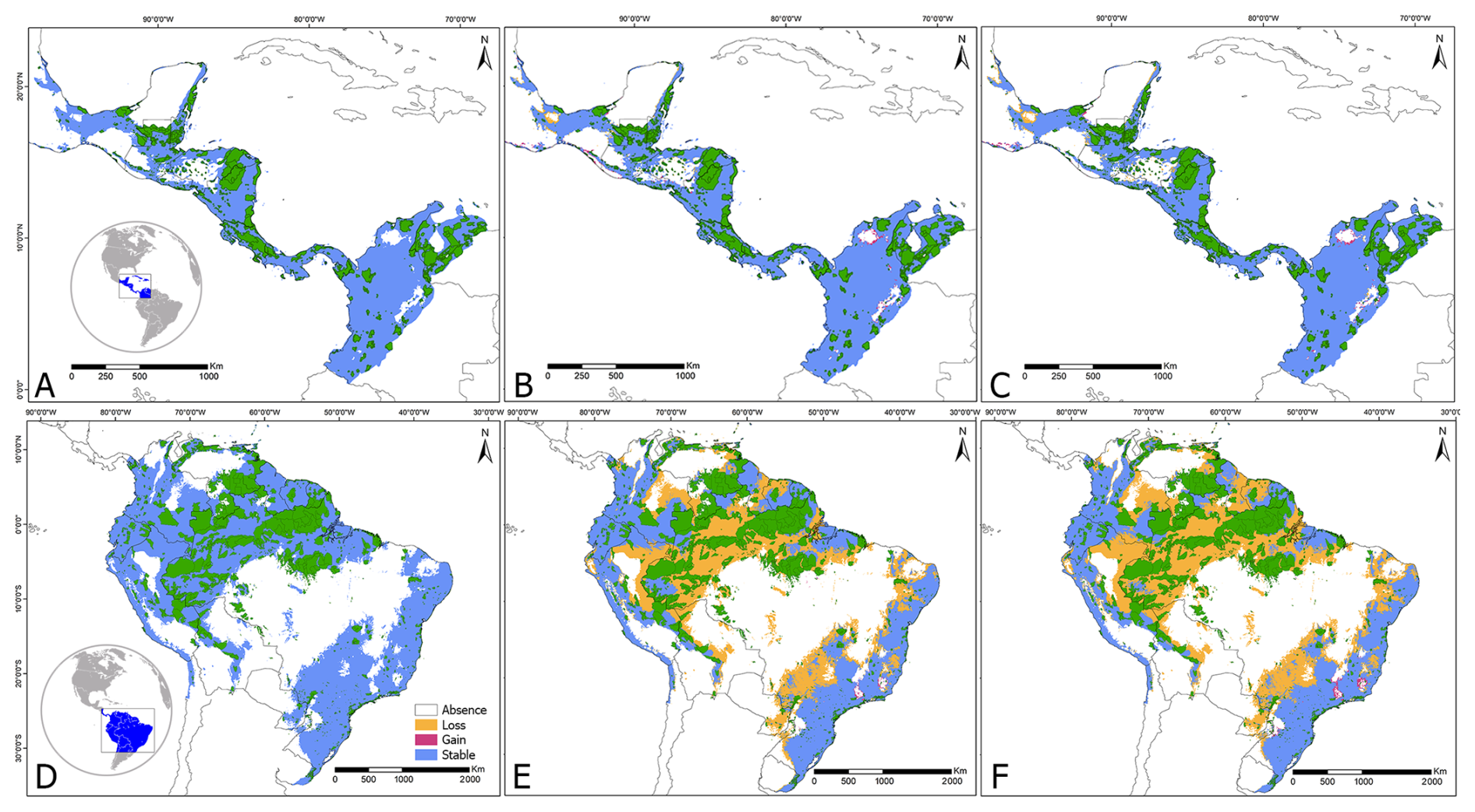
Figure 4Overlap of climatic suitability with protected areas for Vampyrodes major (A–C) and V. caraccioli (D–F) under the current climate (A, D) and future scenarios SSP1-2.6 (B, E) and SSP5-8.5 (C, F). Colours indicate current conditions and projected changes under future scenarios. Green polygons represent protected areas.
Our results provide new insights into how climatic structure shapes the present and future distributional dynamics of Vampyrodes species and their conservation outlook. The climatic characterization of V. major and V. caraccioli shows that their occurrence environments overlap across broad ranges of temperature and precipitation. However, the paired comparisons found statistically significant differences in some variables such as the range of annual temperature and dry-season precipitation, suggesting partially differentiated climatic niches. These differences are consistent with the greater stability of V. major in future scenarios, as suitability for this species is associated with a broader range of temperature and precipitation conditions, which corresponds to lower contractions of suitable areas. In contrast, suitability for V. caraccioli is concentrated within a narrower set of climatic conditions, and under scenarios with higher water stress, this species may experience more severe contractions in climatically suitable areas.
A plausible ecological interpretation is that these patterns reflect differences in the climatic background across their ranges, together with the ecology of canopy frugivorous bats: Vampyrodes depends on forest resources for both food and shelter (Morrison, 1980), and increasing climatic stress (e.g. drought and heat extremes) can directly affect bats through dehydration and heat stress (Welbergen et al., 2008; Salinas-Ramos et al., 2023), and indirectly constrain suitability by altering canopy conditions and fruit-resource availability, potentially compounding habitat degradation effects (Meyer et al., 2016). In the Amazon region, recent extreme drought and warming events highlight the relevance of increasing water stress (Espinoza et al., 2024), which is consistent with the stronger contractions projected for V. caraccioli under drier scenarios. However, the Amazon should not be treated as a climatically homogeneous unit, because subregional differences in precipitation regimes, seasonality, topography, and local buffering conditions can modulate bat persistence and resource availability. Accordingly, projected reductions in suitable climate for V. caraccioli should be interpreted as non-uniform across the Amazon, with some subregions likely functioning as relatively more stable areas than others. This is particularly relevant because local persistence may depend on fine-scale buffering mechanisms not captured by macroclimatic ENMs, such as roost microclimates, forest structure, and riparian habitats that can function as microrefugia. In addition, our MESS analyses indicate that extrapolation risk is not spatially uniform, and areas with stronger environmental novelty should be interpreted with greater caution when assessing future suitability patterns in Amazonia. These patterns may also be consistent with non-exclusive alternatives such as historical biogeographic structure and fine-scale habitat partitioning not captured by macroclimatic predictors, both of which warrant explicit testing with phylogeographic and microhabitat data.
From a phylo-climatic perspective, the combination of broad shared climatic space and partial differentiation is consistent with partial niche conservatism rather than complete climatic niche divergence between V. major and V. caraccioli. Recent phylogenetic work on Vampyressina indicates a relatively recent crown age for Vampyrodes (ca. 2.0 Ma; 95 % HPD: 1.2–3.0 Ma; Garbino et al., 2026), which is compatible with the persistence of a shared climatic background alongside differentiation along specific climatic axes. In this context, the patterns observed here (moderate overlap, high stability, centroid displacement, and asymmetric non-overlapping niche components) may reflect an early stage of climatic niche differentiation superimposed on a common evolutionary niche background.
Although the overlap analyses indicate broad shared climatic space between V. major and V. caraccioli, the combined ecospat results (moderate D/I values, non-rejection of niche equivalency, centroid shift, and asymmetric niche-dynamics components) support partial climatic differentiation rather than complete niche separation. Importantly, this pattern is consistent with the climatic axes that most differentiated the species in the climatic characterization and PCA-env analyses, particularly annual temperature range and dry-season precipitation. A recent study on Vampyrodes also supports the role of climatic seasonality in differentiating V. major and V. caraccioli, linking temperature and precipitation seasonality to morphological divergence and reporting niche divergence between species (Velazco et al., 2026). While that study focused on morphological differentiation and present-day environmental divergence, our work extends this framework by integrating future climatic suitability projections, niche dynamics in PCA-env space, and protected area gap analysis to assess conservation implications under climate change. Thus, overlap in environmental space should not be interpreted as equivalent climatic responses to future change but rather as a combination of shared climatic occupancy and species-specific associations along key dimensions of climatic variability and moisture stress. This pattern also underscores the need for conservation strategies tailored to the specific requirements of each species, especially in the case of V. caraccioli, whose reduction in climatically suitable areas could trigger cascading effects on associated seed-dispersal dynamics in the Amazon (Frick et al., 2020). ENM analyses offer effective tools to understand how environmental variables affect species distributions and their responses to climate change (Pearson and Dawson, 2003). This research details the distribution patterns of a frugivorous bat genus that has been largely understudied to date. Our results highlight the differences in how species of the same genus may respond to potential climate change scenarios, underscoring the need for genus-specific conservation strategies.
Both species are distributed in regions identified as highly vulnerable to climate change: V. major in southern Mexico and Central America, and V. caraccioli in the Amazonian region. These areas are not only biodiversity hotspots but are also consistently ranked among the most exposed to climate-driven shifts in temperature, precipitation, and extreme events (La Marca et al., 2005; Gomes et al., 2019; Espinoza et al., 2024). Scientific syntheses concur that both Mesoamerica and the Amazon basin face compounded threats due to climate instability, land-use change, and habitat fragmentation (Zomer et al., 2016; IPBES, 2018; Hidalgo, 2021). This highlights the urgency of evaluating the potential responses of endemic taxa to future climate scenarios in these regions. In the case of V. major, there is notable stability in its climatically suitable areas under both emission scenarios. However, V. caraccioli experiences a drastic reduction in the extent of climatic suitability, with losses of up to 44.2 % and 50.9 % in both low-emission (SSP1-2.6) and high-emission (SSP5-8.5) scenarios, respectively. These findings suggest that V. major exhibits a broader modelled climatic breadth than V. caraccioli (as inferred from climate-based predictors), potentially reflecting differences in environmental associations, dispersal limitation, or sensitivity to climate-driven shifts in resource availability. Similar results have been found in other studies. For example, Álvarez et al. (2021) analysed changes in the distribution patterns of Vampyrum spectrum (Chiroptera: Phyllostomidae), the largest South American flying mammal. For this species, climate change projections showed responses like those obtained in this study, highlighting climatically stable areas in Central America, while in regions such as the Amazon, climatic conditions changed more drastically. Despite its climatic stability, V. major is not exempt from threats. Ongoing deforestation and agricultural expansion within the species range are expected to substantially reduce the extent and connectivity of suitable forested habitats (Ramírez-Mejía et al., 2017).
The drastic reduction of climatically suitable areas for V. caraccioli aligns with previous studies warning about the vulnerability of frugivorous species to climate alterations. This has been particularly studied in regions like the Amazon, where deforestation and climate change are causing significant transformations in ecosystem structure and composition (Farneda et al., 2020; Festa et al., 2023). Notably, synergies between land-use change and climate warming can further exacerbate habitat loss, fragmenting potential refugia and limiting species' ability to track suitable conditions. The projected habitat loss for V. caraccioli could compromise its role as a seed disperser and, consequently, affect natural regeneration processes in these ecosystems (Frick et al., 2020). Specifically for this species, the reduction of suitable areas under future scenarios could pose a significant challenge to population stability because many bats show strong attachment to home ranges and roosts, and long-distance migration is restricted to a subset of species. This behavioural context may limit the ability of populations to track rapid shifts in climatic suitability through range movements (Lewis, 1995; Popa-Lisseanu and Voigt, 2009; Voigt et al., 2017).
An important aspect to consider regarding the loss of climatically suitable areas is that climate change not only directly affects frugivorous bats but also impacts the plants they depend on for food and shelter (Scheel et al., 1996). Changes in precipitation and temperature patterns can modify plant phenology (Gutiérrez and Trejo, 2022), affecting the temporal and spatial availability of fruits that are essential to species such as V. caraccioli and V. major. Importantly, many tropical plant species exhibit relatively narrow thermal tolerances and increases in mean temperatures; or the frequency of extreme heat events may exceed their physiological limits, leading to reduced growth, reproductive failure, or population decline. These thermal constraints can result in range contractions or shifts independent of precipitation effects (Doughty et al., 2015). Consequently, reductions in plant distribution and abundance may further destabilize plant–bat mutualistic interactions, which are essential for seed dispersal (Velásquez Roa et al., 2023). Studies have shown that the loss of key plant species can compromise the structure of interaction networks, making them more vulnerable to additional disturbances. Therefore, the resilience of these interactions largely depends on the adaptive capacity of both plants and bats to changing climatic conditions (Bascompte and Jordano, 2007).
From a conservation perspective, our results show that the proportion of suitable protected areas varies considerably between the two species. Vampyrodes major maintains a relatively stable percentage of habitat within protected areas, potentially offering some resilience to future climate changes. However, V. caraccioli undergoes a drastic reduction in the availability of climatically suitable conditions within protected areas under future scenarios, with more than 46 % of its current protected habitat projected to be lost. This finding emphasizes the fact that existing reserves, although crucial, may be insufficient to safeguard V. caraccioli if climate and land-use changes continue unabated. Expanding or connecting protected areas through ecological corridors and sustainable land-use planning is therefore vital, especially in regions with higher projected climatic stability (Blake and Loiselle, 2015; Feeley and Silman, 2016).
The notable loss of suitable areas within already established protected areas for V. caraccioli highlights the urgency of designing corridors that connect humid forest zones, particularly in the Amazon basin (Arroyo-Rodríguez et al., 2020). These corridors would not only facilitate the movement of species in search of suitable microclimatic conditions but would also maintain ecological functionality and the ecosystem services associated with seed dispersal and the pollination of key plants (Farneda et al., 2020). By contrast, the relative stability of V. major should not be misinterpreted as invulnerability, given that continuing deforestation and agricultural expansion in Central America can fragment habitats and reduce long-term connectivity (Ramírez-Mejía et al., 2017). Thus, climate change mitigation efforts must be accompanied by comprehensive land-use management that balances forest conservation with human land-use needs.
A key limitation of our regional ENMs is that they capture macroclimatic suitability but may miss fine-scale constraints linked to roost microclimate and shelter availability, which can modulate local persistence even within broadly suitable areas (Pearson and Dawson, 2003). This is especially relevant where our projections indicate stronger contractions and fragmented stability (e.g. V. caraccioli in the Amazon), underscoring the value of integrating microclimatic and roost-related data in future assessments. Finally, because suitable areas and potential climate refugia span national borders, coordinated transboundary planning is likely necessary to translate these projections into effective conservation action. Another limitation concerns the spatial coverage of occurrence records for V. caraccioli across the Amazon basin. Although the species has a broad known distribution, occurrence records remain sparse across large portions of Amazonia, where access limitations and uneven sampling effort may prevent the full climatic heterogeneity of the region from being represented. Consequently, the climatic niche of V. caraccioli may be incompletely characterized, and projected contractions could represent conservative estimates if suitable climates occur in poorly sampled subregions. This limitation reinforces the need for additional occurrence data from undersampled Amazonian areas and for integrating local climatic, roosting, and habitat-use information in future assessments.
While correlative ENMs provide a rigorous framework for macro-scale predictions (Elith and Leathwick, 2009), they can overlook fine-scale determinants in bats, like roost availability, roost microclimates, and topography-driven microrefugia that decouple local conditions from large climate layers (Kearney and Porter, 2009; Dobrowski, 2011; Suggitt et al., 2018). Evidence from bats shows that roost microclimate buffers thermal extremes and shapes physiological limits and behaviour. Deeper cavities and caves moderate heat loads, facilitate social thermoregulation, and influence roost switching (Conenna et al., 2017; Willis and Brigham, 2007). Therefore, future studies should pair multi-season roost and foraging ecology fieldwork with population genomics to determine climate-related local adaptation and source populations with enhanced resilience as integrating adaptive genetic variation into projections can reduce predicted range losses (Razgour et al., 2019). In practice, the integration of microclimate layers and mechanistic limitation with reduced behavioural and genomic data could enhance projections of climate change and inform targeted conservation of microrefugia and roost-quality landscapes (Kearney and Porter, 2009; Bramer et al., 2018).
In conclusion, this study highlights the importance of adopting a preventive approach in the conservation of frugivorous bats, especially those with distributions restricted to vulnerable ecosystems such as the Amazon basin. The combination of climate projections, ecological niche models, and conservation planning provides a solid basis for guiding management decisions and policies in a warming world. Given the significant risk of habitat reduction for V. caraccioli, it is imperative to prioritize conservation actions, including strengthening protected area networks, restoring degraded habitats, and creating corridors while enhancing our understanding of climatic tolerance and other resilience-related traits. Together, these measures will help to ensure the long-term survival of Vampyrodes bats and the critical ecosystem services they provide.
The occurrence points, ecological data, and ecoregions by species are available online at https://doi.org/10.6084/m9.figshare.30590831 (Cruz, 2025a), https://doi.org/10.6084/m9.figshare.30590867 (Cruz, 2025b), and https://doi.org/10.6084/m9.figshare.31462984 (Cruz, 2026a). Wallace session R code for obtaining niche models and transferring them to climate change scenarios and Ecospat R code are available online at https://doi.org/10.6084/m9.figshare.33054794 (Cruz, 2026b) and https://doi.org/10.6084/m9.figshare.32593200 (Cruz, 2026c).
The supplement related to this article is available online at https://doi.org/10.5194/we-26-157-2026-supplement.
SHR: conceptualization (equal), data curation (lead), formal analysis (lead), methodology (lead), writing original draft (lead), review and editing (equal), and visualization (lead). MB: conceptualization (equal), methodology (supporting), data curation (supporting), formal analysis (supporting), and writing (review and editing) (supporting). MJF: conceptualization (equal), methodology (supporting), writing (review and editing) (supporting), supervision (supporting), and resources (equal). DDC: conceptualization (equal), methodology (supporting), data curation (supporting), formal analysis (supporting), writing (review and editing) (supporting), supervision (lead), and resources (equal).
The contact author has declared that none of the authors has any competing interests.
Publisher's note: Copernicus Publications remains neutral with regard to jurisdictional claims made in the text, published maps, institutional affiliations, or any other geographical representation in this paper. The authors bear the ultimate responsibility for providing appropriate place names. Views expressed in the text are those of the authors and do not necessarily reflect the views of the publisher.
The authors acknowledge Reinier Nuñez Bazán for assistance with the drawings of Figs. 3 and 4. The authors also thank three anonymous reviewers for their careful reading of the paper and for their valuable comments and suggestions, which greatly improved the quality of the article.
MJF was supported by Investigadores por México-Secretaría de Ciencia, Humanidades, Tecnología e Innovación (grant no. 73215). Data used in this study were generated within project PAPIIT IN219923.
This paper was edited by Ricardo Rocha and reviewed by Daniel Hending, Camilo Calderon Acevedo, Hugo Rebelo, and one anonymous referee.
Aguiar, L. M., Bernard, E., Ribeiro, V., Machado, R. B., and Jones, G.: Should I stay or should I go? Climate change effects on the future of Neotropical savannah bats, Global Ecology and Conservation, 5, 22–33, https://doi.org/10.1016/j.gecco.2015.11.011, 2016.
Aiello-Lammens, M., Boria, R., Radosavljevic, A., Vilela, B., and Anderson, R.: spThin: An R package for spatial thinning of species occurrence records for use in ecological niche models, Ecography, 38, 541–545, https://doi.org/10.1111/ecog.01132, 2015.
Akaike, H.: A new look at the statistical model identification. IEEE Transactions on Automatic Control, 19, 716–723, https://doi.org/10.1109/TAC.1974.1100705, 1974.
Alkishe, A., Cobos, M. E., Osorio-Olvera, L., and Peterson, A. T.: Ecological niche and potential geographic distributions of Dermacentor marginatus and Dermacentor reticulatus (Acari: Ixodidae) under current and future climate conditions, Web Ecol., 22, 33–45, https://doi.org/10.5194/we-22-33-2022, 2022.
Althoff, S. L., Tribess, B., Reinert, M. J., Ferreira, M. A., and Carvalho, F.: Expansion of the southern limit of Vampyrodes caraccioli Thomas, 1889 (Chiroptera, Phyllostomidae) and first record for Santa Catarina state, southern Brazil, Check List, 13, 871–877, https://doi.org/10.15560/13.6.871, 2017.
Alvares, C. A., Stape, J. L., Sentelhas, P. C., Gonçalves de M., J. L., and Sparovek, G.: Köppen's climate classification map for Brazil, Meteorol. Z., 6, 711–728, https://doi.org/10.1127/0941-2948/2013/0507, 2013.
Álvarez, F., da Silva, S. G., Guevara-Chumacero, L. M., Fernandes Ferreira, F., Alvarez Borla, L., de Sousa, R. F., and Silva, D. P.: The ghost vampire: Spatio-temporal distribution and conservation status of the largest bat in the Americas, Biodivers. Conserv., 30, 4359–4377, https://doi.org/10.1007/s10531-021-02311-7, 2021.
Antonelli, A., Ariza, M., Albert, J., Andermann, T., Azevedo, J. A. R., Bacon, C. D., Faurby, S., Guedes, T., Hoorn, C., Lohmann, L. G., Matos-Maraví, P., Ritter, C. D., Sanmartín, I., Silvestro, D., Tejedor, M. F., Ter Steege, H., Tuomisto, H., Werneck, F. P., Zizka, A., and Edwards, S. V.: Conceptual and empirical advances in Neotropical biodiversity research, PeerJ, 6, 2–53, https://doi.org/10.7717/peerj.5644, 2018.
Araújo, M. B. and New, M.: Ensemble forecasting of species distributions, Trends Ecol. Evol., 1, 42–47, https://doi.org/10.1016/j.tree.2006.09.010, 2006.
Arroyo-Rodríguez, V., Fahrig, L., Tabarelli, M., Watling, J. I., Tischendorf, L., Benchimol, M., and Tscharntke, T.: Designing optimal human-modified landscapes for forest biodiversity conservation, Ecol. Lett., 23, 1404–1420, https://doi.org/10.1111/ele.13535, 2020.
Bascompte, J. and Jordano, P.: Plant–animal mutualistic networks: The architecture of biodiversity, Ann. Rev. Ecol. Evol. S., 38, 567–593, https://doi.org/10.1146/annurev.ecolsys.38.091206.095818, 2007.
Blake, J. G. and Loiselle, B. A.: Enigmatic declines in bird numbers in lowland forest of eastern Ecuador may be a consequence of climate change, PeerJ, 3, e1177, https://doi.org/10.7717/peerj.1177, 2015.
Bramer, I., Anderson, B. J., Bennie, J., Bladon, A. J., De Frenne, P., Hemming, D., Hill, R. A., Kearney, M. R., Korner, C., Körner, C., Lenoir, J., Maclean, I. M. D., Marsh, C. D., Morecroft, M. D., Suggitt, A. J., and Gillingham, P. K.: Advances in monitoring and modelling climate at ecologically relevant scales, Adv. Ecol. Res., 58, 101–161, https://doi.org/10.1016/bs.aecr.2017.12.005, 2018.
Broennimann, O., Fitzpatrick, M. C., Pearman, P. B., Petitpierre, B., Pellissier, L., Yoccoz, N. G., Thuiller, W., Fortin, M.-J., Randin, C., Zimmermann, N. E., Graham, C. H., and Guisan, A.: Measuring ecological niche overlap from occurrence and spatial environmental data, Global Ecol. Biogeogr., 21, 481–497, https://doi.org/10.1111/j.1466-8238.2011.00698.x, 2012
Carvalho, F., Mottin, V., Miranda, J. M., and Passos, F. C.: First record of Vampyrodes caraccioli (Thomas, 1889) (Chiroptera: Phyllostomidae) for the state of Paraná, and range extension to southern region of Brazil, Check List, 10, 1189–1194, https://doi.org/10.15560/10.5.1189, 2014.
Conenna, I., Rocha, R., Russo, D., Cabeza, M., and Real, R.: Insular bats and research effort: A review of global patterns and priorities, Mammal Rev., 47, 169–182, https://doi.org/10.1111/mam.12090, 2017.
Contreras-Díaz, R. G., Nori, J., Chiappa-Carrara, X., Peterson, A. T., Soberón, J., and Osorio-Olvera, L.: Well-intentioned initiatives hinder understanding biodiversity conservation: Cloaked iNaturalist information for threatened species, Biol. Conserv., 282, 110042, https://doi.org/10.1016/j.biocon.2023.110042, 2023.
Cruz, D.: Vampyrodes niche data and localities, figshare [data set], https://doi.org/10.6084/m9.figshare.30590831.v2, 2025a.
Cruz, D.: Vampyrodes ENMeval evaluation metrics, figshare [data set], https://doi.org/10.6084/m9.figshare.30590867, 2025b.
Cruz, D.: Distribution by ecoregions of Vampyrodes major and V. caraccioli, figshare [data set], https://doi.org/10.6084/m9.figshare.31462984, 2026a.
Cruz, D.: Wallace code R, figshare [software], https://doi.org/10.6084/m9.figshare.33054794, 2026b.
Cruz, D.: R code for ecospat analyst, figshare [software], https://doi.org/10.6084/m9.figshare.32593200, 2026c.
Di Cola, V., Broennimann, O., Petitpierre, B., Breiner, F. T., D'Amen, M., Randin, C., Engler, R., Pottier, J., Dubuis, A., Pellisier, L., Mateo, R. G., Hordijk W., Salamin, N., and Guisan, A.: ecospat: An R package to support spatial analyses and modeling of species niches and distributions, Ecography, 40, 774–787, https://doi.org/10.1111/ecog.02671, 2017.
Dobrowski, S. Z.: A climatic basis for microrefugia: The influence of terrain on climate, Glob. Change Biol., 2, 1022–1035, https://doi.org/10.1111/j.1365-2486.2010.02263.x, 2011.
Doughty, C. E., Metcalfe, D. B., Girardin, C. A. J., Amézquita, F. F., Cabrera, D. G., Huasco, W. H., Silva-Espejo, J. E., Araujo-Murakami, A., Da Costa, M. C., Rocha, W., Feldpausch, T. R., Mendoza, A. L. M., da Costa, A. C. L., Meir, P., Phillips, O. L., and Malhi, Y.: Drought impact on forest carbon dynamics and fluxes in Amazonia, Nature, 519, 78–82, https://doi.org/10.1038/nature14213, 2015.
Elith, J. and Leathwick, J. R.: Species distribution models: Ecological explanation and prediction across space and time, Annu. Rev. Ecol. Evol. S., 40, 677–697, https://doi.org/10.1146/annurev.ecolsys.110308.120159, 2009.
Elith, J., Kearney, M., and Phillips, S.: The art of modelling range-shifting species, Methods Ecol. Evol., 4, 330–342, https://doi.org/10.1111/j.2041-210X.2010.00036.x, 2010.
Escobar, L. E., Lira-Noriega, A., Medina-Vogel, G., and Peterson, A. T.: Potential for spread of the white-nose fungus (Pseudogymnoascus destructans) in the Americas: Use of Maxent and NicheA to assure strict model transference, Geospatial Health, 9, 221–229, https://doi.org/10.4081/gh.2014.19, 2015.
Espinoza, J. C., Jimenez, J. C., Marengo, J. A., Schongart, J., Ronchail, J., Lavado-Casimiro, W., and Ribeiro, J. V. M.: The new record of drought and warmth in the Amazon in 2023 related to regional and global climatic features, Sci. Rep., 14, https://doi.org/10.1038/s41598-024-58782-5, 2024.
ESRI (Environmental Systems Research Institute). ArcGIS. Software (Version 10.3.1), http://www.esri.com/software/arcgis (last access: 14 July 2022), 2020.
Eyring, V., Gleckler, P. J., Heinze, C., Stouffer, R. J., Taylor, K. E., Balaji, V., Guilyardi, E., Joussaume, S., Kindermann, S., Lawrence, B. N., Meehl, G. A., Righi, M., and Williams, D. N.: Towards improved and more routine Earth system model evaluation in CMIP, Earth Syst. Dynam., 7, 813–830, https://doi.org/10.5194/esd-7-813-2016, 2016.
Eyring, V., Cox, P. M., Flato, G. M., Gleckler, P. J., Abramowitz, G., Caldwell, P., Collins, W. D., Gier, B. K., Hall, A. D., Hoffman, F. M., Hurtt, G. C., Jahn, A., Jones, C. D., Klein, S. A., Krasting, J. P., Kwiatkowski L., Lorenz, R., Maloney, E., Meehl, G. A., Pendergrass, A. G., Pincus, R., Ruane, A. C., Russell, J. L., Sanderson, B. M., Santer, B. D., Sherwood, S. C., Simpson, I. R., Stouffer, R. J., and Williamson, M. S.: Taking climate model evaluation to the next level, Nat. Clim. Change, 9, 102–110, https://doi.org/10.1038/s41558-018-0355-y, 2019.
Fahrig, L.: Effects of habitat fragmentation on biodiversity, Annu. Rev. Ecol. Evol. S, 34, 487–515, https://doi.org/10.1146/annurev.ecolsys.34.011802.132419, 2003.
Farneda, F. Z., Meyer, C. F., and Grelle, C. E.: Effects of land-use change on functional and taxonomic diversity of Neotropical bats, Biotropica, 52, 120–128, https://doi.org/10.1111/btp.12736, 2020.
Feeley, K. J. and Silman, M. R.: Disappearing climates will limit the efficacy of Amazonian protected areas, Diversity and Distributions, 22, 1081–1084, https://doi.org/10.1111/ddi.12475, 2016.
Festa, F., Ancillotto, L., Santini, L., Pacifici, M., Rocha, R., Toshkova, N., Amorim, F., Benítez-López, A., Domer, A., Hamidovic, D., Kramer-Schadt, S., Mathews, F., Radchulk, V., Rebelo, H., Ruczynski, I., Solem, E., Tsoar, A., Russo, D., and Razgour, O.: Bat responses to climate change: A systematic review, Biol. Rev., 98, 244–266, https://doi.org/10.1111/brv.12893, 2023.
Fialas, P. C., Santini, L., Russo, D., Amorim, F., Rebelo, H., Novella-Fernández, R., Marques, F., Domer, A., Vella, A., Martinoli, A., Figurek, A., Tsoar, A., Sandor, A., Ibáñez, C., Korine, C., Kerbiriou, C., Voigt, C., Mifsud, C., Jére, C., Dalhoumi, R., Preatoni, D., Hamidović, D., Tidenberg, E.-M., Çoraman, E., Mathews, F., Lison, F., Furmankiewicz, J., Petersons, G., Loumassine, H., Garin, I., Csősz, I., Liira, J., Juste, J., Julien, J. F., van der Kooij, J., Josić, D., Aihartza, J., Eldegard, K., Phelps, K., Olival, K. J., Kipson, M., Ancillotto, L., Lesiński, G., Barti, L., Cantú Salazar, L., Bosso, L., Rodrigues, L., Hamel, L., Uhrin, M., Mas, M., Cerekovic, N., Toshkova, N., Roche, N., Kalda, O., Aizpurua, O., Georgiakakis, P., Kanuch, P., Presetnik, P., Bilgin, R., McKay, R. A., Rnjak, D., Rnjak, G., Ruczyński, I., Sørås, R., Robert, S., Aulagnier, S., Kramer-Schadt, S., Gazaryan, S., Bücs, S.-L., Yorulmaz, T., Stjernberg, T., Liukko, U.-M., Nistreanu, V., Vintulis, V., Radchuk, V., Puig-Montserrat, X., Bas, Y., Zagmajster, M., Zegarek, M., Zrnčić, V., and Razgour, O.: Changes in community composition and functional diversity of European bats under climate change, Conserv. Biol., 39, e70025, https://doi.org/10.1111/cobi.70025, 2025.
Fick, S. E. and Hijmans, R. J.: WorldClim 2: New 1‐km spatial resolution climate surfaces for global land areas, Int. J. Climatol., 37, 4302–4315, https://doi.org/10.1002/joc.5086, 2017.
Fleming, T. H., Geiselman, C., and Kress, W. J.: The evolution of bat pollination: a phylogenetic perspective; Ann. Bot., 104, 1017–1043, https://doi.org/10.1093/aob/mcp197, 2009.
Frick, W. F., Kingston, T., and Flanders, J.: A review of the major threats and challenges to global bat conservation, Ann. NY. Acad. Sci., 1469, 5–25, https://doi.org/10.1111/nyas.14045, 2020.
Garbino, G. S. T., Velazco, P. M., and Tavares, V. da C.: Phylogeny, biogeography, and classification of frugivorous bats in the subtribe Vampyressina (Phyllostomidae: Stenodermatinae), with descriptions of new subgenera, B. Am. Mus. Nat. Hist., 479, 1–73, https://doi.org/10.5531/sd.sp.79, 2026.
García-Morales, R., Jacome-Flores, M. E., Hernández-Rodríguez, S., and Pérez-Netzahual, E.: Nuevos Registros De Vampyrodes major (Chiroptera: Phyllostomidae) para Tabasco, México, Mammalogy Notes, 2, 336–341, https://doi.org/10.47603/mano.v8n2.336, 2022.
Graham, C. H., Elith, J., Hijmans, R. J., Guisan, A., Townsend Peterson, A., and Loiselle, B. A.: The influence of spatial errors in species occurrence data used in distribution models, J. Appl. Ecol., 45, 239–247, https://doi.org/10.1111/j.1365-2664.2007.01408.x, 2008.
Global Biodiversity Information Facility: https://www.gbif.org/, last access: 25 June 2025.
Gomes, V. H. F., Viera, I. C. G., Salomao, R. P., and ter Steege, H.: Amazonian tree species threatened by deforestation and climate change, Nat. Clim. Change, 9, 547–553, https://doi.org/10.1038/s41558-019-0500-2, 2019.
Gutiérrez, E. and Trejo, I.: Tree and shrub recruitment under environmental disturbances in temperate forests in the south of Mexico, Bot. Stud., 63, 11–24, https://doi.org/10.1186/s40529-022-00341-0, 2022.
Handley Jr., C. O.: Checklist of mammals of Panama, in: Ectoparasites of Panama, edited by: Wenzel, R. L. and Tipton, V. J., Field Museum of Natural History, 753–795, https://www.biodiversitylibrary.org/part/91358 (last access: 4 August 2026), 1966.
Hernández-Chávez, I., Guevara, L., Arroyo-Cabrales, J., and León-Paniagua, L.: Ecological niche differentiation among Aztec fruit-eating bat subspecies (Chiroptera: Phyllostomidae) in Mesoamerica, Therya, 14, 39–47, https://doi.org/10.12933/therya-23-2214, 2023.
Hidalgo, H. G.: Climate Variability and Change in Central America: What Does It Mean for Water Managers?, Front. Water, 2, https://doi.org/10.3389/frwa.2020.632739, 2021.
Hoorn, C., Wesselingh, F. P., Ter Steege, H., Bermudez, M. A., Mora, A., Sevink, J., Sanmartín, I., Sánchez-Meseguer, A., Anderson, C. L., Figueiredo, J. P., Jaramillo, C., Riff, D., Negri, F. R., Hooghiemstra, H., Lundberg, J., Stadler, T., Särkinen, T., and Antonelli, A.: Amazonia through time: Andean uplift, climate change, landscape evolution, and biodiversity, Science, 330, 927–931, https://doi.org/10.1126/science.1194585, 2010.
Hurvich, C. M. and Tsai, C. L.: A corrected Akaike information criterion for vector autoregressive model selection, J. Time Series Anal., 14, 271–279, https://doi.org/10.1111/j.1467-9892.1993.tb00144.x, 1993.
IPBES: Summary for policymakers of the regional assessment report on biodiversity and ecosystem services for the Americas of the Intergovernmental Science-Policy Platform on Biodiversity and Ecosystem Services, edited by: Rice, J., Seixas, C. S., Zaccagnini, M. E., Bedoya-Gaitán, M., Valderrama, N., Anderson, C. B., Arroyo, M. T. K., Bustamante, M., Cavender-Bares, J., Diaz-de-Leon, A., Fennessy, S., García Márquez, J. R., Garcia, K., Helmer, E. H., Herrera, B., Klatt, B., Ometo, J. P., Rodríguez Osuna, V., Scarano, F. R., Schill, S., and Sampaio Farinaci, J., IPBES Secretariat, Bonn, Germany, 41 pp., https://doi.org/10.5281/zenodo.3236292, 2018
Kass, J. M., Muscarella, R., Galante, P. J., Bohl, C. L., Pinilla-Buitrago, G. E., Minin, V., and Anderson, R. P.: Wallace: A flexible platform for reproducible modeling of species niches and distributions, Methods Ecol. Evol., 9, 1151–1156, https://doi.org/10.1111/2041-210X.12945, 2018.
Kass, J. M., Muscarella, R., Galante, P. J., Bohl, C. L., Pinilla‐Buitrago, G. E., Boria, R. A., Soley-Guardia, M., and Anderson, R. P.: ENMeval 2.0: Redesigned for customizable and reproducible modeling of species' niches and distributions, Methods Ecol. Evol., 12, 1602–1608, https://doi.org/10.1111/2041-210X.13628, 2021.
Kearney, M. and Porter, W.: Mechanistic niche modelling: Combining physiological and spatial data to predict species' ranges. Ecol. Lett., 12, 334–350, https://doi.org/10.1111/j.1461-0248.2008.01277.x, 2009.
Kunz, T. H., Braun de Torrez, E., Bauer, D., Lobova, T., and Fleming, T. H.: Ecosystem services provided by bats, Ann. NY Acad. Sci., 1223, 1–38, https://doi.org/10.1111/j.1749-6632.2011.06004.x, 2011.
La Marca, E., Lips, K. R., Puschendorf, R., Ibáñez, R., Rueda-Almonacid, J. V., Schulte, R., Marty, C., Castro, F., Manzanilla-Pupo, J., García-Pérez, J. E., Bolaños, F., Chaves, G., Pounds, J. A., Toral, E., and Ypung, B. E.: Catastrophic population declines and extinctions in Neotropical harlequin frogs (Atelopus), Biotropica, 37, 190–201, https://doi.org/10.1111/j.1744-7429.2005.00026.x, 2005.
Lewis, S. E.: Roost fidelity of bats: a review, J. Mammal., 76, 481–496, https://doi.org/10.2307/1382357, 1995.
Lim, B. K. and Engstrom, M. D.: Species diversity of bats (Mammalia: Chiroptera) in Iwokrama Forest, Guyana, and the Guianan subregion: Implications for conservation, Biodivers. Conserv., 10, 613–657, https://doi.org/10.1023/A:1016660123189, 2001.
Mancina, C. A., García-Rivera, L., and Miller, B. W.: Wing morphology, echolocation, and resource partitioning in syntopic Cuban mormoopid bats, J. Mammal., 93, 1308–1317, https://doi.org/10.1644/11-MAMM-A-331.1, 2012.
Medellín, R. A. and Gaona, O.: Seed dispersal by bats and birds in forest and disturbed habitats of Chiapas, Mexico, Biotropica, 31, 478–485, https://doi.org/10.1111/j.1744-7429.1999.tb00390.x, 1999.
Meinshausen, M., Nicholls, Z. R. J., Lewis, J., Gidden, M. J., Vogel, E., Freund, M., Beyerle, U., Gessner, C., Nauels, A., Bauer, N., Canadell, J. G., Daniel, J. S., John, A., Krummel, P. B., Luderer, G., Meinshausen, N., Montzka, S. A., Rayner, P. J., Reimann, S., Smith, S. J., van den Berg, M., Velders, G. J. M., Vollmer, M. K., and Wang, R. H. J.: The shared socio-economic pathway (SSP) greenhouse gas concentrations and their extensions to 2500, Geosci. Model Dev., 13, 3571–3605, https://doi.org/10.5194/gmd-13-3571-2020, 2020.
Mello, R. M., Laurindo, R. S., Silva, L. C., Pyles, M. V., Mancini, M. C. S., Dáttilo, W., and Gregorin, R.: Landscape configuration and composition shape mutualistic and antagonistic interactions among plants, bats, and ectoparasites in human-dominated tropical rainforests, Acta Oecol., 112, 103769, https://doi.org/10.1016/j.actao.2021.103769, 2021.
Meyer, C. F. J., Struebig, M. J., and Willig, M. R.: Responses of tropical bats to habitat fragmentation, logging, and deforestation, in: Bats in the Anthropocene: Conservation of bats in a changing world, edited by: Voigt, C. C., and Kingston, T., Springer, Berlin, Germany, 63–103, https://doi.org/10.1007/978-3-319-25220-9_4, 2016.
Miller, B., Reid, F., Arroyo-Cabrales, J., Cuarón, A. D., and de Grammont, P. C.: Vampyrodes caraccioli. The IUCN Red List of Threatened Species 2016, https://doi.org/10.2305/IUCN.UK.2016-3.RLTS.T88151904A22060515.en, 2016.
Miller Jr., G. S.: The families and genera of bats. Bulletin of the United States National Museum, 57, 1–282, 1907.
Morrison, D. W.: Foraging and day-roosting dynamics of canopy fruit bats in Panama, J. Mammal., 61, 20–29, https://doi.org/10.2307/1379953, 1980.
Muscarella, R. and Fleming, T. H.: The role of frugivorous bats in tropical forest succession, Biol. Rev., 82, 573–590, https://doi.org/10.1111/j.1469-185X.2007.00026.x, 2007.
Olson, D. M., Dinerstein, E., Wikramanayake, E. D., Burgess, N. D., Powell, G. V. N., Underwood, E. C., D'Amico, J. A., Itoua, I., Strand, H. E., Morrison, J. C., Loucks, C. J., Allnutt, T. F., Ricketts, T. H., Kura, Y., Lamoreux, J. F., Wettengel, W. W., Hedao, P., and Kassem, K. R.: Terrestrial ecoregions of the world: A new map of life on Earth, BioScience, 51, 933–938, https://doi.org/10.1641/0006-3568(2001)051[0933:TEOTWA]2.0.CO;2, 2001.
O'Neill, B. C., Tebaldi, C., van Vuuren, D. P., Eyring, V., Friedlingstein, P., Hurtt, G., Knutti, R., Kriegler, E., Lamarque, J.-F., Lowe, J., Meehl, G. A., Moss, R., Riahi, K., and Sanderson, B. M.: The Scenario Model Intercomparison Project (ScenarioMIP) for CMIP6, Geosci. Model Dev., 9, 3461–3482, https://doi.org/10.5194/gmd-9-3461-2016, 2016.
Osorio‐Olvera, L., Lira‐Noriega, A., Soberón, J., Peterson, A. T., Falconi, M., Contreras‐Díaz, R. G., Martínez-Meyer, E., Barve, B., and Barve, N.; ntbox: An R package with graphical user interface for modelling and evaluating multidimensional ecological niches, Methods Ecol. Evol., 11, 1199–1206, https://doi.org/10.1111/2041-210X.13452, 2020.
Pearson, R. G. and Dawson, T. P.: Predicting the impacts of climate change on the distribution of species: Are bioclimate envelope models useful?, Glob. Ecol. Biogeogr., 12, 361–371, https://doi.org/10.1046/j.1466-822X.2003.00042.x, 2003.
Peel, M. C., Finlayson, B. L., and McMahon, T. A.: Updated world map of the Köppen-Geiger climate classification, Hydrol. Earth Syst. Sci., 11, 1633–1644, https://doi.org/10.5194/hess-11-1633-2007, 2007.
Pereira, H. M., Leadley, P. W., Proença, V., Alkemade, R., Scharlemann, J. P. W., Fernandez-Manjarrés, J. F., Araújo, M. B., Balvanera, P., Biggs, R., Cheung, W. W. L., Chini, L., Cooper, H. D., Gilman, E. L., Guénette, S., Hurtt, G. C., Huntington, H. P., Mace, G. M., Oberdorff, T., Revenga, C., Rodrigues, P., Scholes, R. J., Sumaila, U. R., and Walpole, M.: Scenarios for global biodiversity in the 21st century, Science, 330, 1496–1501, https://doi.org/10.1126/science.1196624, 2010.
Phillips, S. J., Anderson, R. P., and Schapire, R. E.: Maximum entropy modeling of species geographic distributions, Ecol. Model., 190, 231–259, https://doi.org/10.1016/j.ecolmodel.2005.03.026, 2006.
Popa-Lisseanu, A. G. and Voigt, C. C.: Bats on the move, J. Mammal., 90, 1283–1289, https://doi.org/10.1644/09-MAMM-S-130R2.1, 2009.
Ramírez-Mejía, D., Cuevas, G., Meli, P., and Mendoza, E.: Land use and cover change scenarios in the Mesoamerican Biological Corridor-Chiapas, México, Bot. Sci., 95, 221–234, https://doi.org/10.17129/botsci.838, 2017.
Razgour, O., Forester, B., Taggart, J. B., Bekaert, M., Juste, J., Ibáñez, C., Puechmaille, S. J., Novella-Fernandez, R., Alberdi, A., and Manel, S.: Considering adaptive genetic variation in climate change vulnerability assessment reduces species range loss projections, P. Natl. Acad. Sci. USA, 116, 10418–10423, https://doi.org/10.1073/pnas.1820663116, 2019.
R Core Team: R: A language and environment for statistical computing. R Foundation for Statistical Computing, https://www.r-project.org/ (last access: 3 August 2025), 2024.
Rebelo, H., Tarroso, P., and Jones, G.: Predicted impact of climate change on European bats in relation to their biogeographic patterns, Glob. Change Biol., 16, 561–576, https://doi.org/10.1111/j.1365-2486.2009.02021.x, 2010.
Riahi, K., van Vuuren, D. P., Kriegler, E., Edmonds, J., O'Neill, B. C., Fujimori, S., Bauer, N., Calvin, K., Dellink, R., Fricko, O., Lutz, W., der Popp, A., Crespo, J., Samir, K. C., Leimbach, M., Jiang, L., Kram, T., Rao, S., Emmerling, J., Ebi, K., Hasegawa, T., Havlik, P., Humpenoder, F., Da Silva, L. A., Smith, S., Stehfest, E., Boseti, V., Eom, J., Gernaat, D., Masui, T., Roge, J., Strefler, J., Drouet, L., Krey, V., Luderer, G., Harmsen, M., Takahashi, K., Baumstark, L., Coelman, J., Kainuma, M., Klimont, Z., Marangoni, G., Lotze-Campen, H., Obersteiner, M., Tabeau, A., and Massimo, T.: The Shared Socioeconomic Pathways and their energy, land use, and greenhouse gas emissions implications: An overview, Glob. Environ. Change, 42, 153–168, https://doi.org/10.1016/j.gloenvcha.2016.05.009, 2017.
Salinas-Ramos, V. B., Tomassini, A., Ferrari, F., Boga, R., and Russo, D.: Admittance to wildlife rehabilitation centres points to adverse effects of climate change on insectivorous bats, Biology, 12, 543, https://doi.org/10.3390/biology12040543, 2023.
Scheel, D., Vincent, T. L. S., and Cameron, G. N.: Global warming and the species richness of bats in Texas, Conserv. Biol., 10, 452–464, https://doi.org/10.1046/j.1523-1739.1996.10020452.x, 1996.
Sherwin, H. A., Montgomery, W. I., and Lundy, M. G.: The impact and implications of climate change for bats, Mammal Rev., 43, 171–182, https://doi.org/10.1111/j.1365-2907.2012.00214.x, 2012.
Soberón, J. and Peterson, A.: Interpretation of models of fundamental ecological niches and species' distributional areas, Biodivers. Inform., 2, 1–10, https://doi.org/10.17161/bi.v2i0.4, 2005.
Solari, S.: Vampyrodes major. The IUCN Red List of Threatened Species 2016, e.T88151984A88151987, https://doi.org/10.2305/IUCN.UK.2016-3.RLTS.T88151984A88151987.en, 2016.
Suggitt, A. J., Wilson, R. J., Isaac, N. J. B., Beale, C. M., Auffret, A. G., August, T., Bennie, J. J., Crick, H. Q. P., Duffield, S., Fox, R., Hopkins, J. J., Macgregor, N. A., Morecroft, M. D., Walker, K. J., and Maclean, I. M. D.: Extinction risk from climate change is reduced by microclimatic buffering, Nat. Clim. Change, 8, 713–717, https://doi.org/10.1038/s41558-018-0231-9, 2018.
Téllez-Girón, S. G.: Parte IV. Los mamíferos de México. Orden Chiroptera. Vampyrodes caraccioli (Thomas, 1889), in: Los mamíferos silvestres de México, edited by: Ceballos, G. and Oliva, G., 253–254, CONABIO, ISBN 978-970-9000-30-6, 2005.
Thomas, O.: Description of a new stenodermatous bat from Trinidad, Ann. Mag. Nat. Hist, 6, 167–170, https://doi.org/10.1080/00222938909460492, 1889.
Torres-Olave, M., Bravo-Peña, L. C., Alatorre-Cejudo, L., Uc-Campos, M., and González-León, M. O.: Factores biogeográficos y cambios de uso del suelo (2009–2013) en el nicho de Trogon elegans ambiguus y Euptilotis neoxenus en Chihuahua, México, Geophys. Res. Lett., 44, 763–779, https://doi.org/10.18172/cig.3295, 2018.
Van, P., Gohlke, J. M., and Escobar, L. E.: Future climate change and the distributional shift of the common vampire bat, Desmodus rotundus, Sci. Rep., 15, 59–89, https://doi.org/10.1038/s41598-025-87977-7, 2025.
Velásquez Roa, T., Calvache-Sánchez, C. C., Bernal Rivera, A., Medina Benavides, S. S., and Carvajal, P.: Interacción entre murciélagos frugívoros y plantas en el bosque seco tropical del Valle del Cauca, Colombia, Biota Colomb., 24, https://doi.org/10.21068/2539200x.1078, 2023.
Velazco, P., Carmignotto, A., Aires, C., and Bezerra, A.: Mammalia, Chiroptera, Phyllostomidae, Vampyrodes caraccioli (Thomas, 1889): range extension and revised distribution map, Check List, 6, 49–51, https://doi.org/10.15560/6.1.049, 2010.
Velazco, P. M. and Simmons, N. B.: Systematics and taxonomy of great striped-faced bats of the genus Vampyrodes Thomas, 1900 (Chiroptera: Phyllostomidae), Am. Mus. Novit., 3710, 1–35, https://doi.org/10.1206/3710.2, 2011.
Velazco, P. M., Scholl, C., Johnson, R., Hoos, F., and Esquivel, D. A.: Temperature and precipitation seasonality drive morphological divergence in the neotropical bat genus Vampyrodes (Chiroptera: Phyllostomidae), Mammal Res., 71, https://doi.org/10.1007/s13364-026-00846-0, 2026
Voigt, C. C., Roeleke, M., Marggraf, L., Pētersons, G., and Voigt-Heucke, S. L.: Migratory bats respond to artificial green light with positive phototaxis, PLOS ONE, 12, e0177748, https://doi.org/10.1371/journal.pone.0177748, 2017.
Welbergen, J. A., Klose, S. M., Markus, N., and Eby, P.: Climate change and the effects of temperature extremes on Australian flying-foxes, P. Roy. Soc. B, 275, 419–425, https://doi.org/10.1098/rspb.2007.1385, 2008.
Willis, C. K. R. and Brigham, R. M.: Social thermoregulation exerts more influence than microclimate on forest roost preferences by a cavity-dwelling bat, Behav. Ecol. Sociobiol, 62, 97–108, https://doi.org/10.1007/s00265-007-0442-y, 2007.
Zomer, R. J., Trabucco, A., Bossio, D. A., and Verchot, L. V.: Climate change mitigation: A spatial analysis of global land suitability for clean development mechanism afforestation and reforestation, Agric. Ecosyst. Environ., 126, 67–80, https://doi.org/10.1016/j.agee.2008.01.014, 2016.